

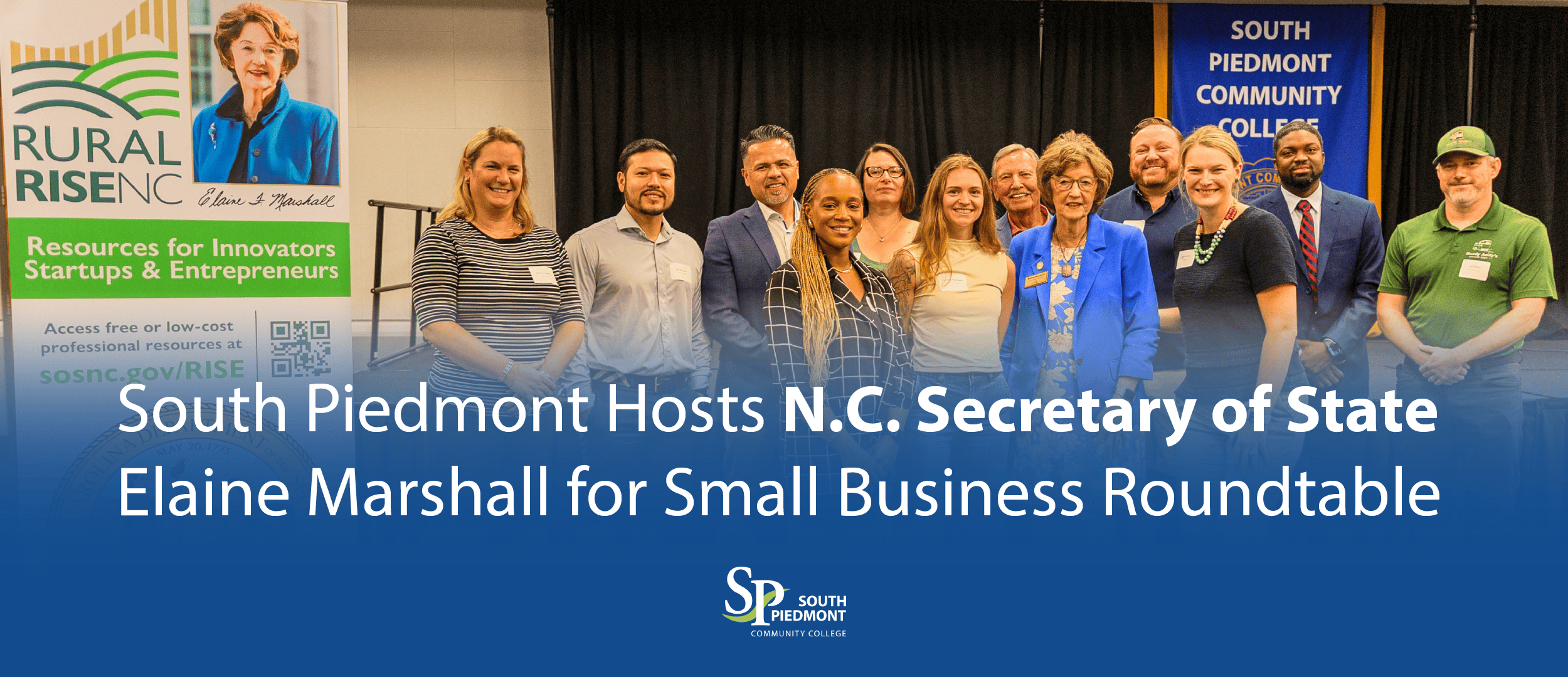
More than 40 entrepreneurs, business leaders, and community partners gathered at South Piedmont Community College to discuss the opportunities and challenges facing North Carolina’s small businesses during a roundtable hosted by the College and featuring North Carolina Secretary of State Elaine Marshall late last month.
Hosted by South Piedmont, the event brought together local business owners representing industries including manufacturing, early childhood education, agriculture, transportation, healthcare, hospitality, and marketing for an open discussion on the realities of starting and growing a business in today’s economy.
Marshall, a former small business owner herself, said entrepreneurship continues to fuel North Carolina’s economy.
“I am thrilled to be here and thrilled to be in sweet Union County,” Marshall said.
She noted that entrepreneurship has grown dramatically across the state since the pandemic.
“Business creation has grown so much in the 2020s,” she said. “Sometimes our most challenging times, like a pandemic, inspire people to create new business ideas.”
Marshall shared that North Carolina is on pace to register approximately 200,000 new businesses this year, with entrepreneurship having doubled since 2017. Union County alone has experienced nearly 58 percent of business growth since the COVID-19 pandemic.
While celebrating that momentum, Marshall also acknowledged the obstacles entrepreneurs face.
“One in four new North Carolina businesses close by its third year,” she said, citing inadequate funding, difficulty finding customers, limited business knowledge, and lack of peer support among the most common challenges reported by entrepreneurs.
Marshall highlighted the Secretary of State’s Rural RISE NC initiative, which connects entrepreneurs—particularly those in rural communities—with business development resources, educational opportunities, and state and local support organizations.
“It’s important that we get it right and send people on their way to success,” she said.
South Piedmont President Dr. Stacy Waters-Bailey said the College has long been committed to helping local entrepreneurs and small businesses succeed.
“For nearly three decades, South Piedmont has partnered with our local small businesses to help them grow and thrive,” Waters-Bailey said. “From training and upskilling employees to providing resources through our Small Business Center—to building the state-of-the-art L. Carlton Tyson Ascend704 Coworking Space—we take deep pride in supporting our local small business community.”
“This is where entrepreneurs and small business owners come for guidance, resources, training, and support,” she said.
Throughout the discussion, business owners described many of the same issues identified in statewide research.
Dr. Taylor Spencer, owner of Wonder Academy, said rising operating costs and staffing shortages remain significant challenges in the early childhood education industry.
“Early childhood education is not supported by the state the way it needs to be,” Spencer said, encouraging continued promotion of programs such as Smart Start to help families and childcare providers.
Commercial Piping & Fabricating owner Lynn Raye, whose company has operated for more than 50 years, encouraged entrepreneurs to remain closely connected to their businesses as they grow.
“Don’t let your company outgrow you,” Raye said. “Be involved in your business always.”
Rodriguez Produce owners Omar and Ivan Rodriguez discussed challenges finding qualified CDL drivers while also learning how to manage rapid business growth.
“Once we get the profit, how do we invest it and save for the future?” they asked. “We feel like that’s why people go out of business—they outgrow themselves.”
Andy Walker, owner of Handy Andy Trailer Service in Indian Trail, credited South Piedmont’s Small Business Center with helping him build a long-term business strategy.
“I realized the business was growing, and that I was the problem—I needed some help,” Walker said. “I took a business class here at South Piedmont, and it helped me create a three-year plan for my business. There are a lot of great resources at South Piedmont.”
Other entrepreneurs shared concerns about marketing, workforce shortages, inflation, visibility, rising operating expenses, and navigating industry regulations.
The roundtable concluded with a shared message: while entrepreneurship continues to grow across North Carolina, strong partnerships among business leaders, educational institutions, and state agencies will be essential to helping new businesses survive and thrive.