

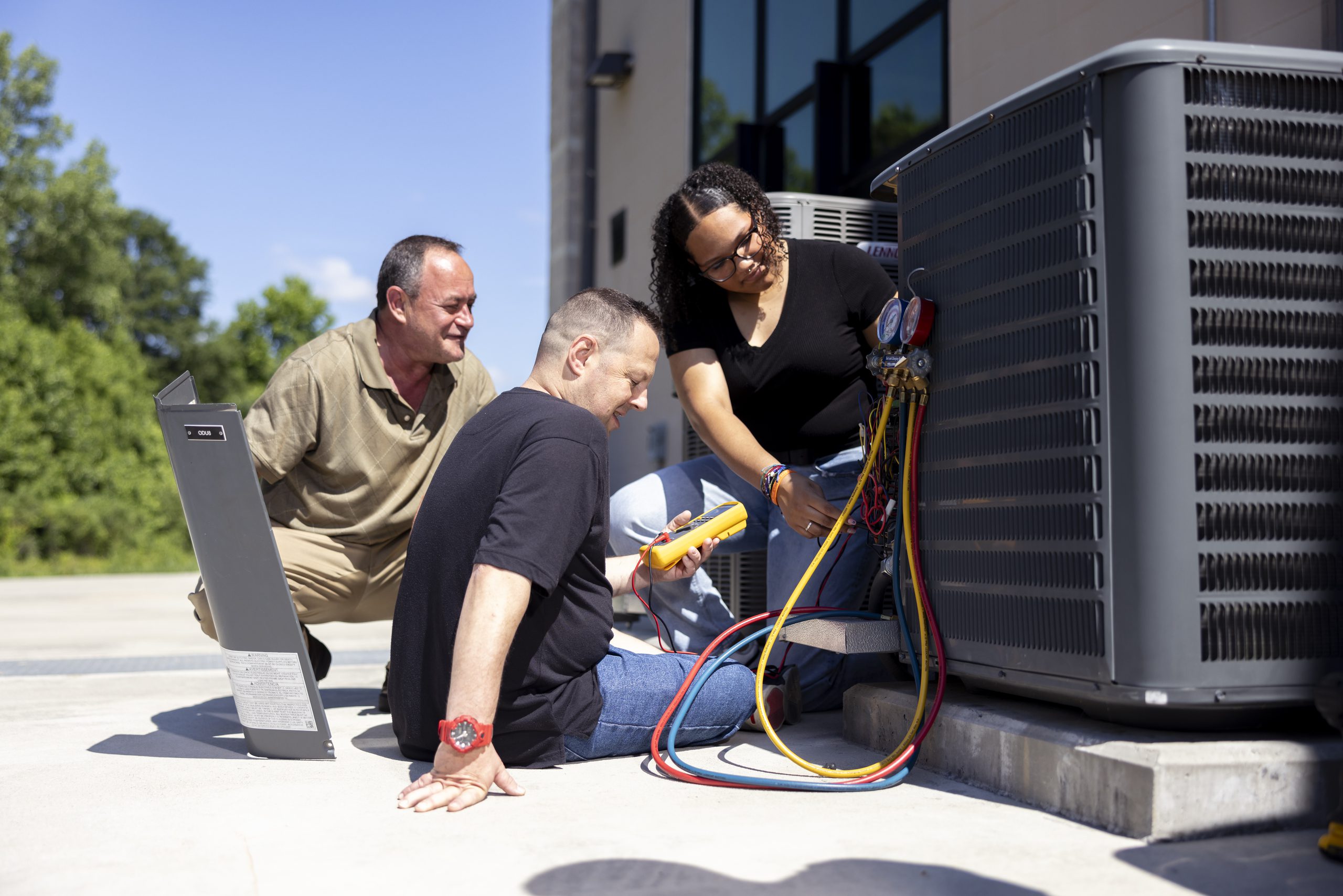
Looking for a cool career? Choose HVAC!
Looking for a career with guaranteed job and growth opportunities? You’ve found it in HVAC.
In Anson and Union counties, between the years of 2014 and 2024, there was an 86 percent increase in HVAC jobs (Lightcast data). You know why? Because our area is growing, and people will always want to be comfortable, whether they’re in their homes, offices, schools, hospitals, etc.
More homes and buildings mean more HVAC systems. And more HVAC systems mean more HVAC jobs.
When you study in South Piedmont’s HVAC program, you’ll be prepared to claim your place in the HVAC industry. You’ll also learn refrigeration, preparing you to specialize in that area if you so choose.
The Program Options
Mode
Online/in-person
Prerequisites
None
Mode
Online/in-person
Prerequisites
Heating Fundamentals Certificate
Mode
Online/in-person
Prerequisites
None
Mode
Online/in-person
None
None
Mode
Online/in-person
Prerequisites
None
Mode
Online/in-person
Prerequisites
None
Mode
Online/in-person
Prerequisites
Unweighted GPA of 2.8
Mode
Online/in-person
Prerequisites
None
2
Locations offering comprehensive HVACR training – L.L. Polk campus and Tyson Family Center for Technology
$63,403
Median salary for HVACR mechanics and installers within our region. Your salary will vary. (Lightcast data, 2026)
U.S. EPA
Students are prepared to receive U.S. EPA Refrigerant and other industry-recognized credentials.
HVAC FAQ
HVAC stands for heating, ventilation, and air conditioning. HVAC technicians install, maintain, troubleshoot, and repair systems such as air conditioners, furnaces, heat pumps, ventilation systems, refrigeration equipment, and indoor air quality systems. HVAC professionals work in residential, commercial, and industrial settings.
South Piedmont’s HVAC program teaches the skills needed to work with residential and light commercial HVAC systems. Coursework includes refrigeration, heating and cooling theory, HVAC electricity, heat pump technology, HVAC controls, system diagnostics, refrigerant certification, indoor air quality, residential system design, and HVAC safety.
The time required depends on the credential you choose. Students can pursue HVAC certificates, diplomas, or an Associate in Applied Science degree. Short-term HVAC credentials can help students quickly gain skills and enter the workforce, while degree programs provide more advanced training in HVAC system design, calculations, building codes, and duct systems on a wide variety of comfort systems
Many HVAC employers value industry certifications, including the EPA Section 608 Certification. South Piedmont students receive training in refrigerant handling and HVAC industry best practices that support preparation for certification and employment opportunities. Certain HVAC classes at South Piedmont will also offer students the EPA Certification exam, which will be a good start for them in the HVAC work place.
HVAC graduates may pursue careers such as:
· HVAC service technician
· HVAC installer
· Refrigeration service technician
· Building maintenance technician
· Commercial HVAC technician
· Facilities maintenance specialist
HVAC professionals are employed by wide range of employers, including mechanical contractors, construction companies, manufacturers, school systems, hospitals, and facility management organizations.
Yes. HVAC is an essential skilled trade because homes, businesses, healthcare facilities, schools, and manufacturing plants all rely on heating and cooling systems. Skilled HVAC technicians are needed to install new systems, maintain existing equipment, improve energy efficiency, and keep facilities operating safely.
HVACR stands for heating, ventilation, air conditioning, and refrigeration. While HVAC focuses primarily on climate control systems, the “R” (refrigeration) focuses on commercial refrigeration equipment such as walk-in coolers, freezers, ice machines, and refrigerated display cases.
No. Many students begin HVAC training with little or no prior experience. South Piedmont’s program starts with foundational concepts such as refrigeration, HVAC electricity, heating technology, safety procedures, and tools before progressing to advanced topics.
South Piedmont provides hands-on HVAC training, experienced instructors, industry-relevant equipment, and affordable pathways to HVAC careers. Students gain practical skills in heating, ventilation, air conditioning, refrigeration, electrical systems, troubleshooting, maintenance, and installation while preparing for entry-level employment in the HVAC industry.
Yes. South Piedmont’s HVAC program includes training in refrigeration technology, which focuses on the systems used to keep food, beverages, medicine, and other products cold. Refrigeration technicians install, maintain, troubleshoot, and repair equipment such as walk-in coolers, freezers, ice machines, refrigerated display cases, and commercial refrigeration systems.
Because refrigeration systems operate using many of the same principles as air conditioning systems, refrigeration training helps students develop a broader skill set and qualify for a wider range of careers. Graduates with HVAC and refrigeration skills may find opportunities in restaurants, grocery stores, convenience stores, warehouses, healthcare facilities, manufacturing plants, and commercial service companies.
Learning both HVAC and refrigeration can increase your job opportunities and prepare you to work on a variety of heating, cooling, ventilation, and refrigeration systems.
Turn Up the Heat on Your HVAC Training
As a student in South Piedmont’s HVAC program, you’ll participate in coursework and hands-on projects designed to teach you to install, maintain, and repair HVAC systems.
You’ll gain a foundational knowledge of air conditioning systems, furnaces, tools, instrumentation, residential building codes, residential system sizing, and advanced comfort systems. You’ll learn from experienced instructors using real HVAC equipment and industry-standard tools. You will be prepared to sit for industry-recognized certifications, such as U.S. EPA Refrigerant, and find employment as a technician, installer, or mechanic.
This industry provides many opportunities for entry-level employees to advance into management or go into business for themselves.
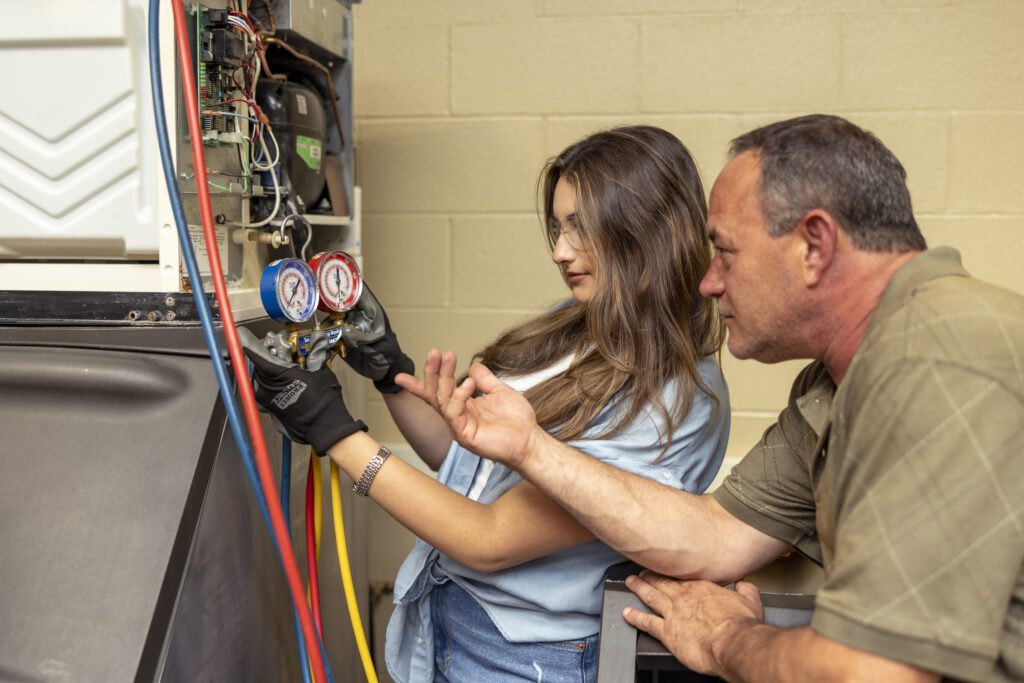

Get Your Hands on Hands-On Training
I enjoyed the HVACR program at South Piedmont because the instructor incorporates hands-on learning in every class and provides real-life scenarios.
Mac Brock, HVAC program graduate and a resident of Polkton
Get Hands-On Experience
Our Work-Based Learning program will help you gain hands-on experience in your field, allowing you to build your resume while you build your job-related knowledge.
Explore Similar Programs
Or go back